
MARVINSLAB · Dice / 1 vs 1 online MarvinsLab · a game of our own

BISCADDADI

A push-your-luck dice game in the Farkle family, with a table for two: send a friend a link and play them from wherever they are. No account, no app, nothing to install. Free, in the browser.

In numbers
12dice, every probability declared
2players at one table, from a link
1die at stake, if you dare

Thirteen turns a match, on average. The table service is our own code: between the two players there is no third-party lobby, no login, no waiting room.

Why we made it

Nobody commissioned this one. Our clients’ games come with a brief and a date; BISCADDADI is what we make when the brief is ours, and it answers the question we get asked most: can you build something two people play against each other, live, from a link? Yes. This is it.

The idea fits in one sentence. Every dice game hides its odds; this one declares them. Twelve dice, each with its own trade: a drop of lead under the six, a die that dreams of being a coin, a fool that plays any face, a debt that buys you budget and charges you every roll. You read the exact odds of every face before you pick it, and nothing is loaded beyond what the label says.

How a duel goes

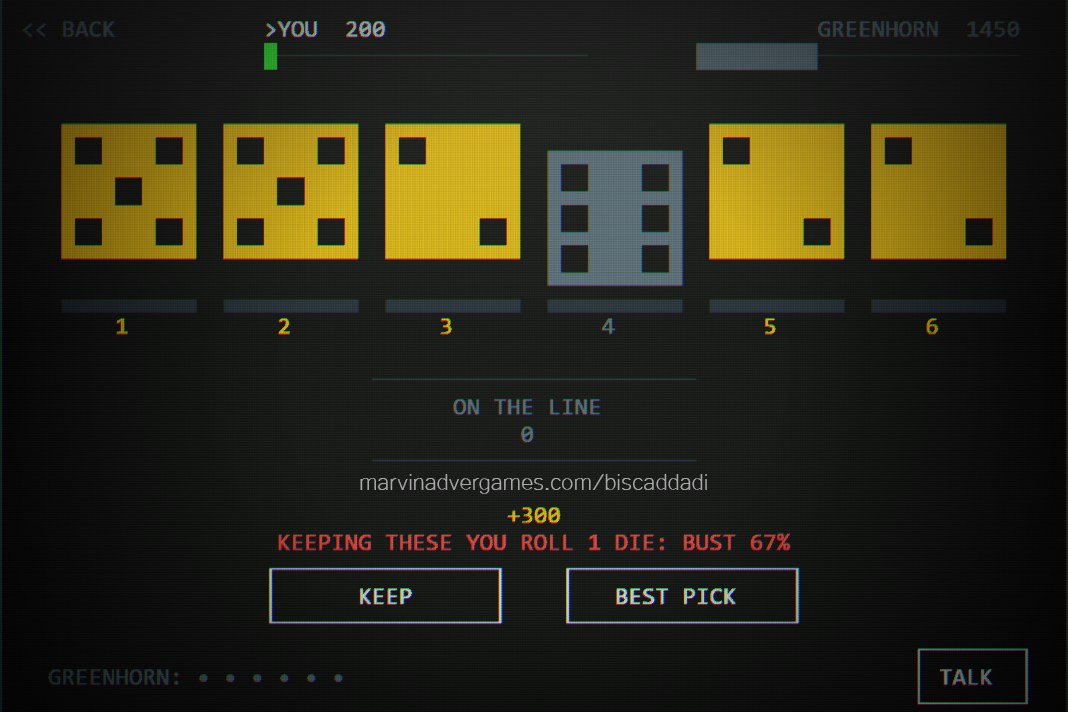
Roll six dice. Keep what scores: ones, fives, triples, straights. Roll the rest, or bank what you have. Roll once too often and the bust takes the whole turn. The first to 4,000 closes the round, not the game: whoever is still owed a turn plays it, and wins only by finishing 500 clear.

Open a table and send the link. The other player opens it on their phone or their computer, and you are at the same table: no account, no app, and nothing in between but our own code. Before you start, one die can be put up: whoever wins the match takes it, and the screen tells you exactly what you are risking before you agree. And at the table you talk: forty-eight lines in six moods, and the other player reads them in their language, Italian or English.

No friend around? Play the house, which shows you its dice before you sit down, or pass the screen to the person next to you.

Drawn in text on an 80-column grid; the CRT is a WebGL2 port of Mattias Gustavsson’s newpixie CRT (MIT).